 I am excited about the progress of broad beans Aquadulce Claudia planted in the autumn, which germinated in the worst cold frosty weather. Some are doing better than others so I may plant a few more seeds just in case. Now must do some gardening!
June view 2009
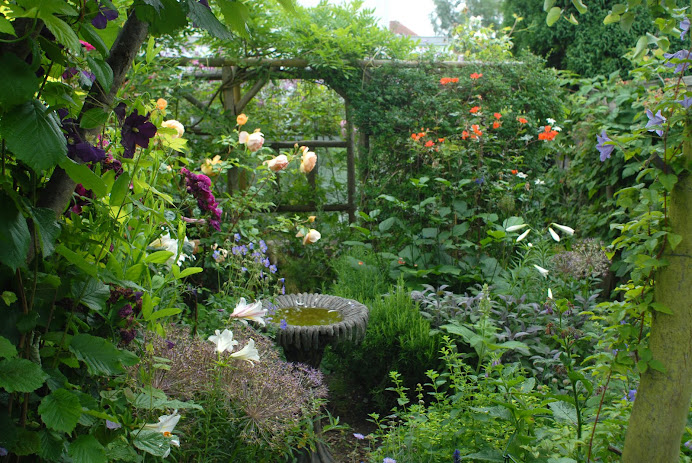
View of rose and herb garden, June 2009
Saturday, 18 March 2017
Seed-planting time
The other day I was reminded how remiss I've been about keeping up this Blog so here's to a better year this year! First of all, these are the seeds I'm about to plant.... Climbing bean Cosse Violette, salad mix Oriental Nice N Spicy and Courgette Black Beauty Dark Fog. After the success of the climbing beans last year I thought I'd have another go, from scratch. My courgette consumption has gone up considerably since the purchase of the wonderful Kiwi brand papaya grater (much better than any spiralising gadget!).  I am excited about the progress of broad beans Aquadulce Claudia planted in the autumn, which germinated in the worst cold frosty weather. Some are doing better than others so I may plant a few more seeds just in case. Now must do some gardening!
I am excited about the progress of broad beans Aquadulce Claudia planted in the autumn, which germinated in the worst cold frosty weather. Some are doing better than others so I may plant a few more seeds just in case. Now must do some gardening!

Monday, 25 July 2016
Suddenly summer and thoughts on ants

The garden has flourished this year and without too much attention. There have been plenty of birds - particularly great tits, blue tits, dunnocks, robins, blackbirds and I'm delighted by the number of sparrows. The swifts are still here in good numbers, I have managed to count about 14 at once but it's quite a challenge as they move so fast. There are also rooks, rather more red kites than I would really like to see and I spotted a flock of starlings along the street the other day but I've not seen them in the garden.
 My Sarah Raven Lilium regale were spectacular but are now over as are the bulk of roses, geraniums and clematis although my very late spring cutting back of one of them was definitely a good move as it is still flowering, much later than usual. Two well-established phlox are doing really well. I am now eagerly awaiting the dahlias starting to bloom although they seem to be very slow so far....
On the radio they have talking about ants, claiming they do no damage. Hm. I'm not so sure. They have definitely been responsible for killing off several things here by excavating around plant roots. A splendid self-set white lychnis (left of top picture) upped and died suddenly last week and when I removed it there was virtually no root. Maybe or maybe not ants.... They are certainly farming black fly on the dahlias and that is not welcome.
One surprise observation I must note. The white perennial sweet pea (below) has been turning increasingly pink over the years and I assumed it was reverting. This year it is perfectly white again. Delight!

Wednesday, 6 July 2016
Russian ballet colours
Irrespective of the last two posts, I have to share this rose and clematis combination with you. What my late Aunties would have called Russian ballet colours....

Trying to grow Ipomoea lobata
I am always tempted by climbers. They are great for filling odd spaces and experimenting with the annual varieties is great fun! Seduced by the beautiful display of Ipomoea (Mina) lobata I saw last year in St James's park, London, I ordered some seedlings from Sarah Raven and 8 lovely little plants arrived this spring - April I think!.
After a week or so I decided it should be safe to plant them out. Cautious, I only planted out 3, gave one to a friend and kept 4 inside in pots. Alas, the ones I planted out very soon succumbed to the unexpected late frosts. Looking a little sad and straggly I put my remaining 4 outside to harden off in early May. One was attacked by snails and proved insufficiently strong to recover so I brought the other 3 back indoors. They did not flourish - the leaves became distorted and pale and the plants grew straggly. Reading about them it seems they do not like rich living so I transplanted into rather poorer garden soil than the compost I initially used. I popped 2 in the greenhouse and they began to flower almost immediately with hardly any leaf/stem growth. Another I put in a window box with some petunias.
I am watching and waiting eagerly. Here is a picture of the healthiest when first transplanted. I will report progress - hoping for the best. Any advice very welcome!
After a week or so I decided it should be safe to plant them out. Cautious, I only planted out 3, gave one to a friend and kept 4 inside in pots. Alas, the ones I planted out very soon succumbed to the unexpected late frosts. Looking a little sad and straggly I put my remaining 4 outside to harden off in early May. One was attacked by snails and proved insufficiently strong to recover so I brought the other 3 back indoors. They did not flourish - the leaves became distorted and pale and the plants grew straggly. Reading about them it seems they do not like rich living so I transplanted into rather poorer garden soil than the compost I initially used. I popped 2 in the greenhouse and they began to flower almost immediately with hardly any leaf/stem growth. Another I put in a window box with some petunias.
I am watching and waiting eagerly. Here is a picture of the healthiest when first transplanted. I will report progress - hoping for the best. Any advice very welcome!

A most unattractive water-inhabiting visitor - rat-tailed maggots!
We have had so much rain recently that water accumulated in places it never had before. In a ceramic pot base, which is sealed at the bottom, some dead leaves had fallen and begun to decay. Among them I noticed a collection of mosquito larva but also some much larger really rather disgusting-looking white/transparent maggot-like creatures with long rat-like tails - commonly known as rat-tailed maggots!. It seems they are either Syrphid or Hover fly or Drone fly larvae. Either way, I'll be glad when they hatch out and fly off! Fascinating none-the-less....


Saturday, 11 June 2016
June rain
 We seem to be quite lucky not to have major floods so I'm not complaining about the gentle rain that's interrupted my planned dahlia-planting. In fact it's perfect growing weather and the roses are loving it.


For the first time I can recall, roses that usually hang their heads down and standing upright. Is this due to all the rain? Whatever, R Prince Charles and R Pat Austen are covered in blooms and the delicate old fashioned white rose (whose name I've forgotten) is flourishing too following total neglect from me last year (another object-lesson?). Dispatched 5 lily beetles this morning and chucked out a good deal of large slugs and snails with the tulips. I'm sure the lily beetles were making a squeaking noise - not sure if this is possible.... They have not yet discovered two pots of very healthy-looking l.Formosanum and l.Regale near the kitchen. The latter, bulbs from Sarah Raven, are stunning plants a good five feet in height and growing strong and straight.
Saturday, 4 June 2016
Madame Isaac Pereire and Madame Alfred Carriere and co.
 A remarkably warm, dry bank holiday weekend has been followed by torrential rain today which makes me delighted I picked a bunch of full-blown roses for the table! This year there are more blooms than ever before - maybe due to all the rain and a late cold snap... easy to speculate. The bad new is that R. Kiftsgate is covered with mildew that I can't begin to think about tackling. I am seriously considering cutting it right back after flowering this year to see if I can keep it a little more under control/healthy.... The grass would be happy!
I am intrigued by the habits of roses and my various experiments with pruning. Most remarkable to me is how forgiving they can be, especially as regards transplanting. I am happy to report that the good half day I spent digging out R Canary Bird to give to a friend has been rewarded by it taking - in spite of my having to cut back to only about 1/4 of the root.
 My creamy-white Mme. Alfred Carriere rose was also a major task to transplant but since I've realised I should tie down all the stems to allow the flowering spurs to grow upwards it has been flourishing and is relatively free of any pests or diseases. Unlike the supposedly well-behaved pretty pink Mme. Isaac Pereire. This was my first rose purchase and is in its third location - ever-looking for a place it is happy. It is blighted by black spot and seems to attract aphids, although it does seem quite mildew-resistant. This year I have decided to ignore it and let it ramble and that seems to be suiting it. Amongst the wisteria and a tangle of greenery the black-spotty leaves will just have to do their own thing, while I collect as many as I can.
 After the slow spring there are some wonderful surprises this year - plenty of self-set alliums (in fact they need dividing!), a fabulous crop of white irises, unexpected foxgloves and some surprising combinations of foliage plants. The clematis all seem to be very slow but hopefully they will come late and give me more to look forward to!
My orange-purple tulip contrasts were a success overall although some of the colour shifts were a bit too subtle from a distance. I picked a couple of bunches to shoot in the studio this year - both fresh and as they die gracefully. A few may even reach the web site. Nice to give things more permanent significance. Next weekend I shall be digging them up to make space for dahlias.
Here are a couple of snaps of the garden this weekend. I am so chuffed my hosta Francis Williams has so far avoided any slug/snail damage!.


Subscribe to:
Posts (Atom)